
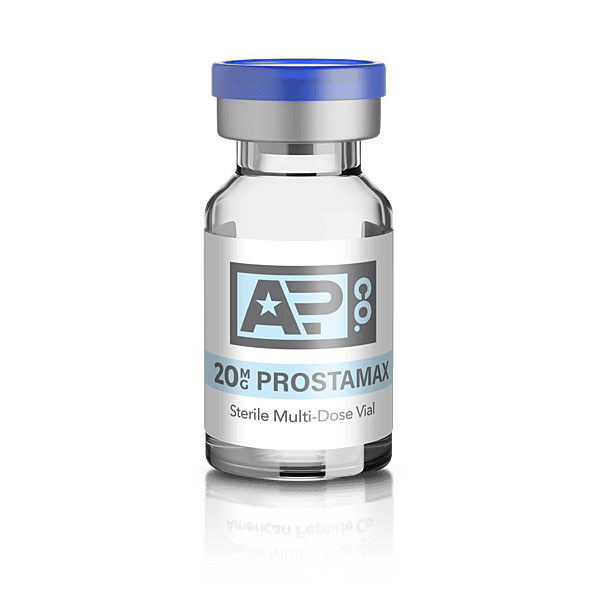
Prostamax (20mg)
Prostamax is a synthetic short peptide from the Khavinson tissue-specific bioregulator series, designed for research on prostatic tissue. Investigated in the broader context of male urological and reproductive function research alongside other tissue-specific peptide bioregulators.
About Prostamax
Prostamax is a synthetic short peptide developed within the Russian peptide research program established by Dr. Vladimir Khavinson at the St. Petersburg Institute of Bioregulation and Gerontology. It belongs to the same family of "tissue-specific bioregulators" as Epithalon, Pinealon, and Cartalax — small peptides derived from peptide extracts of corresponding organ tissues. Prostamax was developed specifically for research applications relating to prostatic tissue, which plays a central role in male urological and reproductive function.
Mechanism in Research Literature
Research on Prostamax and the broader Khavinson short-peptide class has documented:
- Tissue-specific gene expression modulation in research models
- Penetration of cells and entry into the nucleus where peptides may influence transcription
- Effects on protein synthesis patterns in target tissue cell models
- Modulation of cellular proliferation and differentiation markers
- Tissue-specific activity proposed in Khavinson research literature
Research Context
Prostamax has been investigated within the Khavinson peptide research program exploring:
- Prostatic tissue cellular research and gland-specific bioregulator pharmacology
- Male urological function research in aging cellular models
- Male reproductive function research and prostatic contribution to seminal fluid composition
- Tissue-specific peptide bioregulator pharmacology across the Khavinson class
- Comparative gene expression profiling in tissue-specific peptide research
- Aging research in tissue-specific cellular models
Related Research Peptides
Prostamax appears in literature alongside other Khavinson tissue-specific bioregulators (Epithalon, NA Epithalon, Pinealon, Cartalax) and is contextually relevant to broader male reproductive and sexual function research compounds including PT-141 (central melanocortin pathway), Kisspeptin (upstream HPG axis signaling), and HCG (LH-receptor activation).